


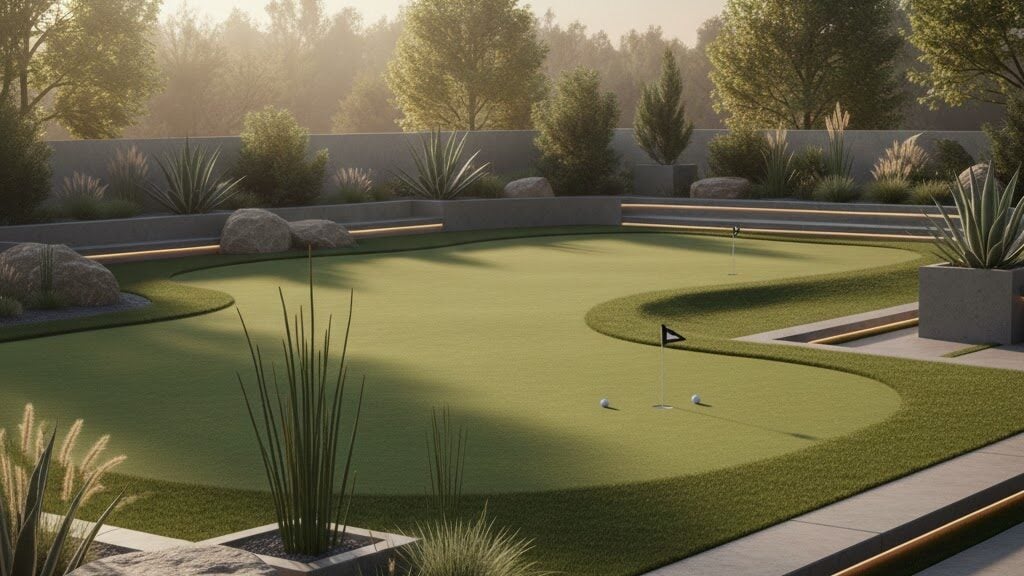
Backyard putting greens are purpose-built outdoor golf practice areas using artificial grass to replicate putting surfaces while integrating into residential landscaping. Advances in turf technology, smarter drainage, and multi-functional landscape design make 2026 a pivotal year for homeowners seeking low-maintenance, high-playability short game areas that also boost property value. This guide explains the leading design trends, material choices, luxury add-ons, and the realistic cost and installation options you should expect when planning a residential putting green. You will learn how fiber types and infill affect ball roll, why base preparation and drainage determine longevity, how smart sensors and lighting extend play hours, and which sustainable turf options reduce water and maintenance demands. The article maps trend overviews, a turf-technology comparison, premium feature choices, installation decision frameworks, maintenance routines, and the ways a putting green can enhance outdoor living and resale appeal. Throughout, target keywords like artificial grass putting green, synthetic turf golf green, custom golf green design, and putting green maintenance tips will be woven into practical, design-forward advice for 2026 projects.
What Are the Top Backyard Putting Green Trends Homeowners Will Love in 2026?
A backyard putting green in 2026 blends purposeful practice space with broader outdoor living, leveraging realism in turf, sustainability in materials, and multi-use design to increase year-round utility. These trends work by combining improved synthetic turf engineering, smart controls, and landscape architecture so homeowners gain a functional short game area that also supports entertaining and low water use. The direct benefit is a versatile outdoor zone that requires minimal mowing and delivers consistent ball roll; the mechanism behind that value is modern fiber engineering, engineered base systems, and integrated drainage that preserve roll quality through wet and dry cycles. Below is a concise list of the top trends that define contemporary residential greens and set expectations for aesthetics and performance.
- Multi-functional outdoor living integration that places greens alongside kitchens, seating, and play zones.
- Complete customization including contours, logos, and multi-hole layouts sized to yard and use.
- Hyper-realistic turf, advanced drainage systems, and infill choices for year-round performance.
- Sustainability through recycled-content fibers, low-toxicity infill, and reduced water demand.
- Smart-tech integration for lighting, performance tracking, and remote controls.
These five trends form the design backbone for most modern installations and guide choices about turf selection, grading, and accessory features. Understanding how multi-functionality and sustainability interact helps determine whether the green becomes a focal entertainment area or a dedicated practice amenity, which in turn shapes base work and material selection for longevity.
How Are Multi-Functional Outdoor Living Spaces Shaping Putting Green Designs?
Multi-functional outdoor living spaces place the putting green within a broader entertainment and activity sequence, allowing families to shift from cooking, dining, and lounging to short game practice without separate, disjointed zones. Designers create flow by aligning sightlines, using shared hardscape materials, and adding transition elements such as fringe zones, pathways, and integrated seating that encourage spillover use while preventing foot-traffic damage to adjacent plantings. The reason this works is that well-planned adjacency reduces conflict between active and passive uses and increases overall time-on-site for both golfers and non-golfer household members, yielding a better lifestyle ROI for the landscape. For safe, cohesive design, prioritize gradual transitions, non-slip surfaces near kitchens or wet areas, and visual continuity using matching pavers or border colors to tie the green into the patio palette. Thoughtful placement also preserves usable lawn area for kids or pets; placing a compact multi-hole green near an outdoor kitchen can deliver both entertaining drama and structured practice without compromising circulation or aesthetics.
Why Is Complete Customization Key in Modern Putting Green Designs?
Complete customization allows homeowners to match skill objectives and aesthetic goals by specifying contours, breaks, hole locations, and graphic elements like logos or borders, delivering both practice realism and visual identity. The mechanism is simple: tailored grading and turf selection produce specific ball-speed and break characteristics, while personalized edging and fringe create a finished look that complements existing landscape themes. The benefit is measurable—custom contours provide progressive difficulty for practice, while branded or themed elements enhance entertaining value and curb appeal when executed with restraint. Examples include a compact multi-hole loop for a family yard, a professional-length practice line for serious players, or a decorative logo tucked into a fringe area that reads well from the patio. When planning customization, scale changes incrementally and use mockups or digital renderings to validate how contours read in full-scale before committing to earthwork.
How Does Artificial Grass Technology Enhance 2026 Putting Green Designs?
Artificial grass technology enhances putting green designs by delivering engineered fibers, advanced backing and drainage systems, and infill solutions that collectively control ball roll, UV stability, and surface longevity. These material advances work through specific attributes—fiber type and pile height determine resilience and roll, backing technologies enable dimensional stability, and infill tunes firmness and ball response—resulting in more realistic play and lower seasonal maintenance. For homeowners, the key benefit is a synthetic turf golf green that mimics natural greens closely enough for meaningful practice while requiring far less water and mowing. The table below compares common turf fiber options and product attributes to help you select a surface that balances playability and durability for your yard.
| Turf Type | Key Attribute | Typical Value / Recommendation |
|---|---|---|
| Polyethylene (PE) | Realistic feel and smooth ball roll | Soft, natural feel with PGA-style roll; ideal for putting surfaces and most backyard greens |
| Polypropylene (PP) | Budget-friendly option | More affordable; best for decorative areas or light practice use |
| Hybrid (PE Blend) | Balanced performance | Combines the softness of polyethylene with added resilience; great for multi-use greens and consistent playability |
This comparison shows that polyethylene and hybrid systems often best replicate putting surfaces while nylon excels where strength is needed; selecting the right turf depends on usage patterns and desired ball roll. Recent improvements in UV stabilizers, coated backings, and permeable secondary backings also reduce seam issues and increase usable days per year by improving wet-weather drainage and dimensional stability.
What Are the Best Artificial Grass Types for Realistic Putting Greens?
Polyethylene fibers are the preferred choice for realistic putting greens because their softer, flatter blade profiles support a smooth, consistent ball roll and a more natural appearance. This comes from the fiber’s flexibility and face weight, which influence how the ball interacts with the surface—higher face weight and lower pile height generally lead to more controlled roll performance. Polypropylene can work as an entry-level option for small practice areas, though it’s less durable and better suited for light-use setups. Hybrid systems that blend polyethylene with other supportive yarn types in structural zones can also provide a good balance of roll quality and wear resistance. When selecting a product, focus on turf engineered specifically for putting applications, including published ball-roll data, UV stability ratings, and recommended infill to match your practice goals.
Introductory note: the next table provides a clear EAV-style comparison to aid selection.
| Fiber Material | Pile Height | Face Weight | UV Stability | Recommended Infill |
|---|---|---|---|---|
| Polyethylene (PE) | 6–10 mm | Medium | High | Fine silica sand or Envirofill for smooth, consistent ball roll |
| Polypropylene (PP) | 6–10 mm | Low | Medium | Light silica sand; a cost-effective option for low-use practice areas |
| Hybrid (PE Blend) | 6–12 mm | Medium–High | High | Targeted infill mix depending on usage zones—ideal for multi-purpose greens |
This table summarizes trade-offs: choose polyethylene or hybrid systems for putting surfaces aimed at realistic roll, reserve nylon for edges or high-wear transitions, and match infill density to the desired speed and firmness.
How Do Eco-Friendly Synthetic Turf Options Support Sustainable Landscaping?
Eco-friendly synthetic turf options support sustainability through recycled-content fibers, non-toxic infill choices, and by reducing irrigation and chemical inputs compared with natural grass. The reason these options matter is lifecycle impact: materials with recycled polymers lower virgin resource demand, while infill alternatives such as advanced envirofill reduce microplastic migration and improve drainage performance. The direct benefits to homeowners include measurable water savings, lower ongoing fertilizer and mowing emissions, and a reduced maintenance schedule that lowers lifecycle carbon and cost. Look for turf products that disclose recycled content percentages and that specify non-toxic or rounded-granule infill designed to stay in place and support consistent ball roll. While synthetic turf is not impact-free, selecting recycled, low-toxicity materials and combining them with permeable base systems creates a lower-maintenance, resource-efficient putting surface that aligns with sustainable landscape goals.
This approach to sustainable landscaping, where design choices inherently minimize ongoing upkeep, is a core principle for modern, eco-conscious outdoor spaces.
Sustainable Landscape Design for Low-Maintenance Putting Greens
Management by design – where the landscape design embodies a consideration of the costs of the management process and options for minimizing maintenance overheads. For example, the use of appropriate plant species and materials can significantly reduce the need for irrigation, fertilization, and pest control, contributing to a more sustainable and cost-effective landscape.
Which Luxury Features Elevate Backyard Putting Greens in 2026?
Luxury features elevate backyard putting greens by adding functionality, ambiance, and data-driven practice tools that increase utility for both entertainment and skill development. These premium add-ons include integrated LED lighting to extend play into evening hours, smart sensors that track putt metrics, built-in seating and hardscape for spectator comfort, and engineered multi-tiered surfaces that introduce visual drama and practice variety. Each feature adds a quantifiable homeowner benefit—lighting extends use, sensors provide training data, and tiered construction increases the range of short-game practice scenarios—while also raising the overall aesthetic and experiential value of the outdoor space. The table below contrasts common luxury features so you can weigh benefits, cost implications, and maintenance impact when deciding which upgrades suit your yard and budget.
| Feature | Benefit | Rough Cost Impact |
|---|---|---|
| LED Lighting | Extends play hours; adds ambiance | Moderate |
| Smart Sensors | Performance tracking and remote data | Moderate–High |
| Water Features | Visual appeal and focal point | High |
| Integrated Seating / Hardscape | Increased entertaining function | Moderate |
How Do Smart Technologies Integrate with Putting Greens for Enhanced Play?
Smart technologies integrate via embedded sensors, mobile apps, and lighting controls that together deliver performance feedback and flexible ambiance control for practice and entertaining. Sensors measure metrics like putt speed, line, and make percentage and transmit data to apps that help golfers track progress over time; the mechanism is sensor → data capture → analytics → user feedback, enabling targeted practice sessions. Integration with home automation systems lets homeowners schedule lighting scenes or practice drills that cue music and lamps for social events, increasing the green’s multi-functional role. Consider power and connectivity needs—sensor packages and lighting require planning for low-voltage wiring, access to Wi-Fi or local controllers, and weatherproofing to maintain reliability. For many homeowners, the payoff is a smarter practice environment that makes training measurable and entertainment more engaging, but smart features should be specified with serviceability and firmware-update paths in mind.
- Smart sensors provide shot metrics and session logs that support incremental practice.
- App integrations enable remote lighting control and scheduled practice reminders.
- Power and waterproof housing are essential to maintain long-term sensor reliability.
In summary, smart tech elevates practice by turning qualitative putting into measurable progress, but factor installation complexity and maintenance needs into your budget and layout plan.
What Design Elements Create Multi-Tiered and Undulating Putting Surfaces?
Multi-tiered and undulating surfaces are created through careful grading, retaining elements, and precise base preparation that combine to produce controlled breaks, slopes, and elevation changes for advanced short-game practice. The technique involves shaping subgrade contours, building compacted aggregate terraces or retaining edges where needed, and installing geotextile and base layers that preserve design geometry under play and weather. Slope design should respect recommended degrees of incline for realistic play—gentle transitions and well-defined lips create predictable breaks while steeper compound surfaces offer higher difficulty for advanced training. Construction implications include increased excavation, enhanced drainage planning to prevent pooling on flat spots, and added material costs for retaining or terracing; these trade-offs yield practice variety and visual interest that can significantly upgrade the experience. A balanced tiered green integrates plantings and hardscape to unify the overall landscape while safeguarding the putting surface from erosion and runoff.
The concept of dynamic topography for practice is not new, with research exploring how programmable greens can offer varied and realistic training experiences.
Transformable Putting Greens: Custom Topography for Realistic Practice
This report discusses the design of a prototype transformable putting green that can be programmed to recreate the topography of any putting green. The goal of the design was to give a realistic putting experience with real topography in an indoor environment.
Re-Configurable Putting Green, 2012
What Are the Cost and Installation Options for Backyard Putting Greens in 2026?
Understanding cost and installation options requires distinguishing between DIY kits, standard professional installs, and premium custom installations, because each path differs in base quality, drainage performance, warranty coverage, and long-term playability. Costs vary based on size, complexity, contouring, and accessory features, with typical project ranges provided below to guide homeowner budgeting. The three-option framework—DIY kit, professional standard install, and premium custom install—helps homeowners weigh immediate expense against expected longevity and performance. Below is a concise cost-range summary followed by a detailed EAV comparison to help readers decide which route fits their yard, skill goals, and budget.
- DIY kit: Lower upfront cost, suited for small practice patches and temporary solutions.
- Professional standard install: Mid-range cost with engineered base, good drainage, and installer warranty.
- Premium custom install: Higher cost for custom contours, heavyweight base preparation, advanced drainage, and extended warranties.
These options map to different expectations for life span and playability; professional installation typically delivers the most consistent ball roll and warranty coverage, while DIY kits are best for short-term or experimental projects.
Intro to comparison table: the table below contrasts DIY kits, standard professional installation, and premium custom installation across cost, time, warranty, and expected performance.
| Installation Option | Typical Investment Level | Estimated Timeline | Warranty & Support |
|---|---|---|---|
| DIY Kit | Lower investment; best for very small greens or basic practice setups | Usually completed in 1–2 days depending on prep work | Limited manufacturer support; no professional installation coverage |
| Professional Standard Install | Mid-range investment suitable for most backyard putting greens | Typically 3–7 days, depending on grading and base preparation | Installer-backed workmanship warranty with standard maintenance guidance |
| Premium Custom Install | Higher investment for multi-hole greens, contours, bunkers, or advanced features | Larger projects may take 1–3 weeks depending on design complexity | Extended warranties with design support, performance guarantees, and long-term service options |
This comparison highlights that professional installs command higher upfront costs but generally ensure better drainage, base compaction, and overall performance expectations that translate to longer useful life and consistent ball roll.
Should Homeowners Choose Professional Installation or DIY for Their Putting Green?
Choosing between professional installation and DIY depends on yard complexity, desired longevity, and tolerance for maintenance and troubleshooting; professionals are generally necessary when contours, drainage, or multi-zone integration are planned. The mechanism favoring professionals is their ability to design and construct a compacted aggregate base with appropriate slope, implement geotextile separation, and integrate linear or French drains that prevent settlement and pooling—actions that materially affect ball roll and lifespan. DIY kits can be a cost-effective entry point for small practice pads or temporary practice loops, but they often lack the engineered base or comprehensive drainage needed for year-round use and may void manufacturer expectations for warranty if base preparation is inadequate. When selecting professional services, prioritize installers who specify professional-grade base compaction, quality seam work, and warranty documentation; these factors significantly influence long-term performance and resale value.
- Professionals deliver engineered base and drainage solutions that preserve roll.
- DIY is viable for small, flat practice areas but not for complex contours.
- Warranties and post-installation support usually favor professional installers.
In short, homeowners aiming for realistic roll, complex contours, or long-term value should invest in professional installation, while DIY remains an option for budget-limited, small-scale practice setups.
Why Is Proper Drainage and Base Preparation Essential for Longevity?
Proper drainage and base preparation create a structurally stable foundation that prevents pooling, reduces freeze-thaw movement, and preserves consistent ball roll by maintaining the intended grade and cushion. The base system typically includes compacted aggregate, geotextile separation, and a permeable layer that allows water to pass through rather than collect on the surface; this mechanism keeps the turf dry and stable in wet weather and prevents substrate settlement that causes uneven roll. Performance metrics tied to good base work include increased usable days per year, reduced maintenance, and fewer repairs—poor base preparation often yields settled seams, inconsistent roll, and higher long-term costs. Common mistakes to avoid are shallow excavation, inadequate compaction, lack of slope for runoff, and omission of geotextile layers; addressing these during installation reduces the chance of costly remediation later. For homeowners, investing in a professionally designed base and drainage pays off through predictable play and longer turf life.
Introductory how-to list: essential base construction steps are summarized below.
- Excavate to design depth and shape subgrade contours for desired slopes.
- Install geotextile fabric to separate subgrade from aggregate and prevent migration.
- Place and compact aggregate base layers to specified compaction rates.
- Add a leveling or shock-absorbent layer, then turf with appropriate infill and seam work.
To summarize, durable performance and realistic ball roll hinge on methodical base work and targeted drainage solutions—these elements are not optional if you want a green that performs for many seasons.
Note on services: homeowners seeking professional-grade base work, guaranteed drainage solutions, and documented warranties can engage trained installation and design services that specialize in synthetic turf putting greens; such service options typically include design consultation, engineered base construction, and post-installation support or warranty documentation. Requesting a detailed scope of work and warranty terms before installation helps align expectations and protect long-term value.
How Can Homeowners Maintain Their Artificial Putting Greens for Long-Term Performance?
Maintaining an artificial putting green requires regular brushing, debris removal, targeted infill management, and periodic inspections to preserve pile integrity and consistent ball roll characteristics. The mechanism is routine surface restoration—brushing reorients fibers to an upright position, infill topping adjusts firmness, and cleaning prevents organic matter from degrading backing or creating odors—resulting in sustained playability and appearance. The main benefits to adhering to a schedule are extended turf life, maintained roll speed, and reduced likelihood of spot repairs; well-maintained greens remain predictable across seasons and require far less intensive intervention. Below is a compact maintenance checklist formatted for practical use with frequency and action items optimized for homeowners.
Maintenance checklist intro: the numbered list below outlines frequency and actions.
- Weekly: Remove leaves and organic debris with a soft rake or blower to prevent staining and infill contamination.
- Monthly: Brush high-traffic and putting lanes with a stiff broom to lift pile and redistribute infill for even roll.
- Quarterly: Inspect seams, edging, and drainage outlets; top up infill in low spots and perform spot seam repairs if needed.
- Yearly: Schedule a professional inspection for backing integrity, base settling, and replace infill or perform deep cleaning as recommended.
Following this routine preserves play characteristics and reduces the need for disruptive repairs; professional maintenance plans can supplement DIY care for optimal longevity. For homeowners who prefer hands-off care, periodic professional inspections and infill rejuvenation services provide proactive upkeep and document condition for future resale.
What Are the Best Practices for Cleaning and Infill Management?
Cleaning and infill management starts with preventing organic matter accumulation, using appropriate tools, and selecting infill materials that support desired ball roll while minimizing compaction and displacement. Weekly debris removal with a leaf blower or soft brush prevents staining and microbial buildup; for pet waste, remove solids promptly and rinse the area, using turf-approved enzymatic cleaners when necessary to neutralize odors without damaging fibers. Infill inspection involves checking for low-density zones near seams or edges and adding measured top-ups of silica or polymerized envirofill to restore base firmness and roll speed. The choice of infill affects maintenance: finer silica sands enable tighter roll but may compact; rounded polymer infills resist compaction but can present higher cost—select based on play goals and maintenance tolerance. A balanced program of brushing, targeted top-ups, and occasional professional deep-cleaning maintains both aesthetics and performance for many seasons.
How Long Do Professionally Installed Synthetic Greens Typically Last?
Professionally installed synthetic greens typically last between 10 and 20 years depending on turf quality, UV stabilization, base construction, usage intensity, and maintenance practices. The reason for this lifespan range is that product longevity is not just a function of fiber durability but also of how well the base, drainage, and seams were implemented—high-quality installations coupled with routine maintenance extend usable life toward the higher end of the range. Warranties vary with installer and product, but longer warranties often correlate with better base standards and higher-grade turf; confirming warranty coverage for UV, fiber wear, and seam integrity helps set realistic expectations. Usage patterns such as heavy daily training, pet traffic, or exposure to extreme sunlight can accelerate wear, while proactive care like scheduled brushing and infill management slows degradation. Ultimately, investing in professional installation and maintaining a disciplined maintenance schedule maximizes return on the surface over its useful life.
Note on maintenance services: homeowners can choose to manage routine cleaning and infill themselves or enroll in professional maintenance plans that provide scheduled inspections, decompaction, and infill replenishment to keep greens performing at a high level and to document condition for warranty claims.
How Do Backyard Putting Greens Increase Property Value and Enhance Outdoor Living?
Backyard putting greens increase property value and enhance outdoor living by creating a differentiated, low-maintenance amenity that appeals to buyers seeking lifestyle-oriented landscaping and usable outdoor spaces. The mechanism is the combination of tangible utility (practice and recreation) and improved curb appeal when a green is integrated tastefully into the landscape; used wisely, a well-designed green can signal thoughtful outdoor investment and increase perceived usable square footage. While exact ROI varies by market and level of customization, tasteful installations that preserve neutral palettes, avoid overly niche branding, and include transferable warranty documentation generally attract broader buyer interest than highly personalized or eccentric themes.
- Putting greens can broaden the appeal of a property by adding recreational amenities without ongoing mowing costs.
- Neutral designs with tasteful fringe and edging tend to attract more buyers than highly personalized logos or themes.
- Documentation of installation methods and warranties enhances buyer confidence and supports resale narratives.
To summarize, when executed with restraint and quality construction, backyard putting greens can be a persuasive selling point that complements existing landscaping and boosts outdoor living functionality.
What Is the Impact of Putting Greens on Home Resale Value?
The impact on resale value depends on how the green is designed relative to neighborhood expectations and market demand; in markets where outdoor lifestyle amenities are prized, a tasteful putting green can differentiate a property and contribute to perceived value. The mechanism of value uplift stems from demonstrable utility, durability, and aesthetic integration that reduce perceived future maintenance burden while offering immediate recreational benefit. Data points vary regionally, but practical guidance is to favor neutral, multi-use designs rather than hyper-personalized or overly specialized installations that narrow buyer pools. Presenting maintenance records, warranty transfers, and clear documentation about base construction and drainage reduces buyer uncertainty and increases the likelihood that the green will be viewed as a value-adding improvement rather than a niche customization.
How Do Putting Greens Complement Broader Landscaping and Outdoor Design?
Putting greens complement broader landscaping by acting as a unifying green plane that links patios, paths, plantings, and play zones while requiring less water and mowing than natural turf alternatives.
Design pairings that work well include native plant buffers for low-maintenance edges, warm-toned pavers or decomposed granite to match patio materials, and thoughtful transition zones like fringe areas that soften the line between lawn and hardscape. Practical layout templates range from compact multi-hole loops adjacent to an outdoor kitchen to elongated practice lanes that run parallel to a pool or terrace, each balancing circulation and sightlines. Transition elements—edging, planting strips, and subtle grade changes—help the putting green read as an intentional part of the landscape rather than an isolated feature and increase both aesthetic cohesion and functional flow.
If you are planning a backyard putting green, consider engaging professional design and installation services that specialize in custom layouts, eco-friendly turf options, advanced drainage systems, and realistic ball roll; requesting a design consultation or a written quote can help you compare engineered base approaches, warranty terms, and maintenance plans so that your green delivers both playability and lasting value.


