

Infill strongly influences an artificial lawn’s durability, comfort, and maintenance. Different infill materials change wear resistance, drainage, heat retention, and how the surface responds to UV exposure. This article compares common infills and summarises installation and maintenance practices to help you select and manage infill for better turf life.
Types of Infill Materials and Their Properties
Infill stabilises the backing, cushions impacts, and helps fibres remain upright. Common choices—silica sand, crumb rubber, and organic blends—offer different trade-offs in stability, cushioning, and thermal behaviour.
How Do Silica Sand, Crumb Rubber, and Organic Infill Materials Compare?
Evaluate stability, shock absorption, drainage, heat retention, and environmental profile to pick the right infill for your site.
- Silica Sand: Affordable and stable, sand helps keep fibres upright and drains well.
- Crumb Rubber: Made from recycled tyres, it gives good cushioning for sports but can retain heat.
- Organic Infill: Materials such as coconut fibre, cork, or coated walnut shells feel softer and typically run cooler; they are more eco-friendly but have different durability characteristics.
Recent studies continue to compare organic and rubber infills, emphasising environmental impact and load performance.
Comparing Organic & Rubber Infill for Artificial Turf Performance
Styrene butadiene rubber crumb is the most widely used performance infill worldwide. Growing concern about microplastics and potential health effects has increased interest in organic performance infills. This study analysed the relationship between normal stress and rotational traction for three infill materials: styrene butadiene rubber, cork, and pine. The results underscore the need for clearer performance data on organic infills to ensure safety and consistent performance.
Investigating normal stress effects on the shear and traction characteristics of performance infill materials used in artificial turf surfaces, H McGowan, 2025
| Infill Type | Properties | Best Uses |
|---|---|---|
| Silica Sand | Affordable, stable, good drainage | Residential lawns, playgrounds |
| Crumb Rubber | Shock-absorbent, durable | Sports fields, high-traffic areas |
| Organic Infill | Eco-friendly, soft feel | Residential lawns, environmentally conscious projects |
Match density, cushioning, drainage, and thermal behaviour to your application and local climate for best results.
What Are the Technical Specifications and Performance Attributes of Each Infill Type?
Key properties include bulk density, particle size distribution, elasticity (rebound), and thermal conductivity. Sand’s density provides stability; rubber’s elasticity gives impact attenuation; organic materials are lighter and softer underfoot.
Those properties determine compaction rate and behaviour under traffic and weather; specify infill by these metrics to improve longevity.
How Does Infill Density Influence Artificial Grass Durability and Performance?
Installed infill density (mass per unit area) is crucial for durability and appearance. Correct density supports fibres and helps the surface resist deformation.
What Is the Relationship Between Infill Density and Turf Wear Resistance?
Higher installed density generally improves wear resistance by supporting fibres and reducing matting, which matters most in high-traffic areas.
How Does Infill Affect Drainage and UV Resistance in Synthetic Turf?
Proper infill preserves void spaces so water can reach the base, preventing pooling. Infill does not provide UV protection—UV stability is a fibre property—but correct infill reduces mechanical wear that can hasten UV-related degradation.
Also consider heat retention and particle migration, since both affect comfort and environmental performance.
Artificial Turf Infill: Heat & Particle Migration Impacts
Heat affects all artificial turf systems. Some infills increase surface temperature, while others help dissipate heat, which impacts comfort and material lifespan. Migration of infill particles from the turf is a documented environmental and performance concern.
Artificial turf infill: a comparative assessment of chemical contents, L Pollard, 2020
What Are the Best Practices for Installing Infill to Optimize Turf Longevity?
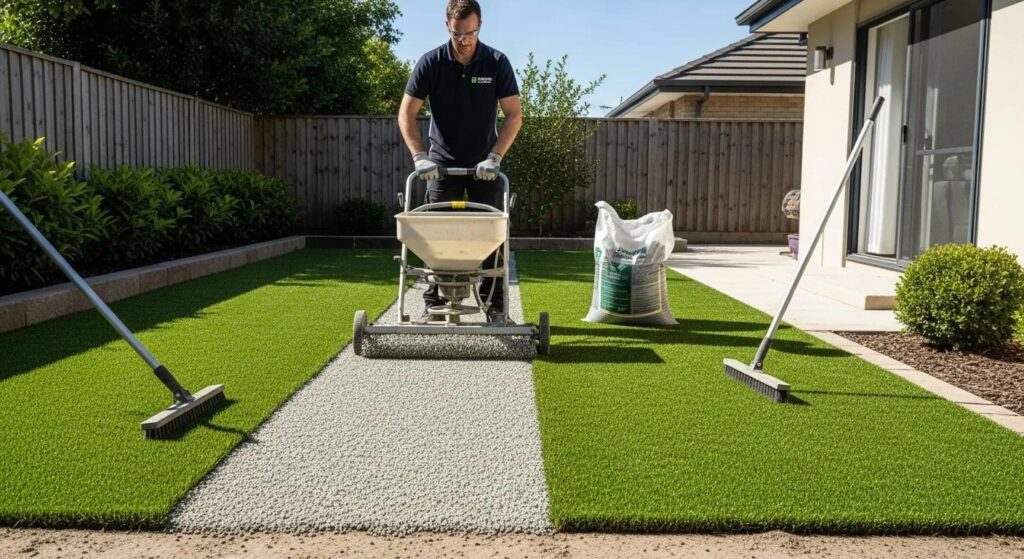
Follow established installation protocols: a stable base, controlled infill depth, and equipment that ensures even distribution.
Which Installation Techniques Ensure Proper Infill Distribution and Turf Stability?
- Base Preparation: Level and compact the base before infill to create a solid foundation.
- Even Distribution: Use a spreader or a broom to distribute infill evenly and avoid uneven wear.
- Depth Check: Verify infill depth regularly to keep it within recommended ranges.
Evidence shows specialist spreading equipment reduces migration and supports long-term performance.
Minimizing Infill Migration for Optimal Turf Longevity
A study of European synthetic turf fields estimated that infill migration is a significant environmental concern. Using specialist infill spreading equipment during installation ensures even distribution and supports long-term performance and longevity.
Determining the effectiveness of Risk Management Measures to minimize infill migration from synthetic turf sports fields, 2020
How Do Installation Supplies and Application Methods Impact Turf Performance?
Using high-quality supplies and proper application improves drainage and stability. Artificial Turf Express offers a range of installation supplies for contractors, landscapers, and DIY homeowners.
How Should Artificial Turf Infill Be Maintained and Replenished for Maximum Lifespan?
Regular inspection and maintenance preserve infill performance and slow degradation.
What Are Recommended Maintenance Schedules and Procedures for Infill Care?
- Regular Inspections: Periodically check for uneven wear or compaction.
- Cleaning: Remove debris and organic matter to prevent mould and odours; leaf blowers and rakes work well.
How Often Should Infill Be Replaced or Topped Up to Preserve Turf Quality?
Top up or replace infill when you see matting, reduced cushioning, fibres that do not stand or bare patches. Regular upkeep extends service life.
If you need project support, contact Artificial Turf Express for technical guidance on product selection and installation.
Artificial Turf Express supplies a broad selection of products and guidance to help specify and install the right turf for your site.
Frequently Asked Questions
What factors should I consider when choosing infill for artificial grass?
Consider turf type, use, traffic, climate, and environmental impact. Silica sand stabilises fibres; crumb rubber offers impact attenuation; organic infills are softer and typically cooler. Also, evaluate drainage and thermal behaviour.
How does the choice of infill affect the maintenance of artificial grass?
Infill affects cleaning frequency and methods. Crumb rubber may need more cleaning to manage odours and trapped debris; organic infills can degrade faster and need topping up. Plan maintenance around the selected material.
Can infill materials affect the temperature of artificial grass?
Yes. Crumb rubber tends to retain heat, while organic materials (cork, coconut fibre) generally dissipate heat better and can create a cooler surface. Factor in local climate and sun exposure when choosing.
What are the environmental impacts of different infill materials?
Impacts vary: crumb rubber raises concerns about microplastics and leaching, while organic infills are biodegradable and often renewable. Balance performance needs with environmental implications.
How can I tell if my infill needs to be replenished?
Look for flattened fibres, reduced cushioning, uneven surfaces, or exposed backing. If fibres no longer stand or you see bare patches, inspect and replenish as needed. Routine checks every few months are sensible, more often for heavy use.
What are the best practices for cleaning artificial grass infill?
Remove leaves and debris with a leaf blower or rake, use a turf brush to lift fibres and redistribute infill, and wash with water and mild detergent for deeper cleaning. Regular brushing prolongs the performance and appearance of infill.
Conclusion
Choosing the right infill is fundamental to maximising performance and service life. Compare the stability, cushioning, drainage, and thermal behaviour of silica sand, crumb rubber, and organic options, then match each material to its application and climate. Combine proper installation and routine maintenance to protect your investment. For expert support and product options, review the offerings from Artificial Turf Express.


