


High-quality artificial grass isn’t a green plastic carpet. Every blade is engineered for a specific look, feel, and level of durability, and the spec sheet tells you which one you’re getting, if you know how to read it.
The two numbers that matter most are pile height (how tall the blades are) and face weight (how much fiber is packed into the turf). This guide explains both, shows how they work together, and covers the questions they lead to: how thick artificial turf is, what it weighs per square foot, how to convert inches to millimeters, and the best pile height for lawns, pets, play areas, and putting greens.
What Is Artificial Turf Pile Height?
Pile height is the length of the grass blade, measured from the top of the backing to the tip of the blade. In the US it’s usually listed in inches; many manufacturers and overseas brands list it in millimeters.
Picture measuring a natural lawn from the soil to the tip of each blade. That’s pile height.
Artificial turf pile heights generally range from about 0.4 inches on the shortest putting surfaces to around 3 inches on the tallest ornamental turfs.
How to Measure Pile Height
Lay a ruler against the backing and gently straighten a few blades so they stand upright. Measure from the backing to the tip. Don’t count the backing itself, and don’t measure the curly thatch layer at the base, since it’s shorter than the main blades.
Pile Height Conversion: Inches to Millimeters
| Inches | Millimeters (approx.) |
|---|---|
| 3/8″ | 10 mm |
| 1/2″ | 13 mm |
| 0.47″ | 12 mm |
| 1″ | 25 mm |
| 1.25″ | 32 mm |
| 1.5″ | 38 mm |
| 1.75″ | 44 mm |
| 2″ | 51 mm |
| 2.5″ | 64 mm |
To convert yourself, multiply inches by 25.4, or divide millimeters by 25.4. A 12 mm pile height is just under half an inch, which puts it in short-pile territory: firmer and flatter, like a tightly mowed lawn rather than a lush one.
Short Pile vs. Long Pile Artificial Turf
Short Pile Turf (About 1/2″ to 1″)
Short (low pile) turf looks like a closely mowed lawn or a well-kept sports field. Because there’s less blade to bend over, it holds its upright look under heavy use and resists matting. It’s also easier to clean, which matters for pets.
The trade-off is a firmer feel underfoot, since there’s less blade length to cushion each step.
Long Pile Turf (More Than 1″)
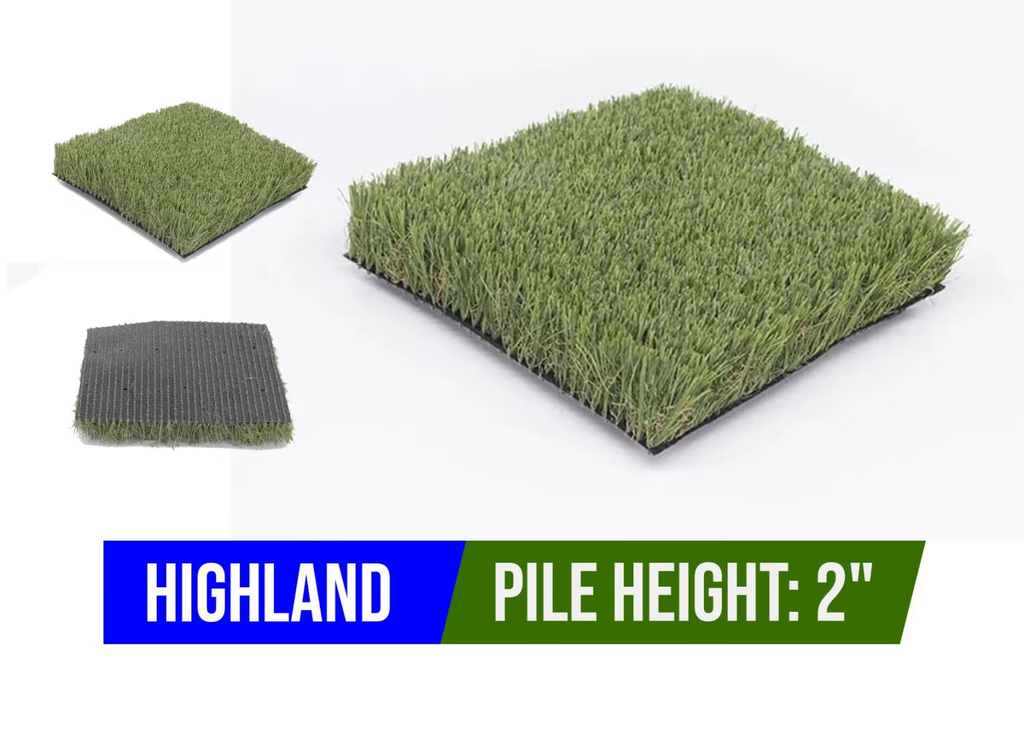
Long pile turf delivers a lush, soft, freshly mowed look and a plush feel for bare feet. The trade-off is that longer blades bend over more easily, so they can flatten in high-traffic paths and need more regular brushing to stand back up.
Putting Green Turf (Under 1/2″)
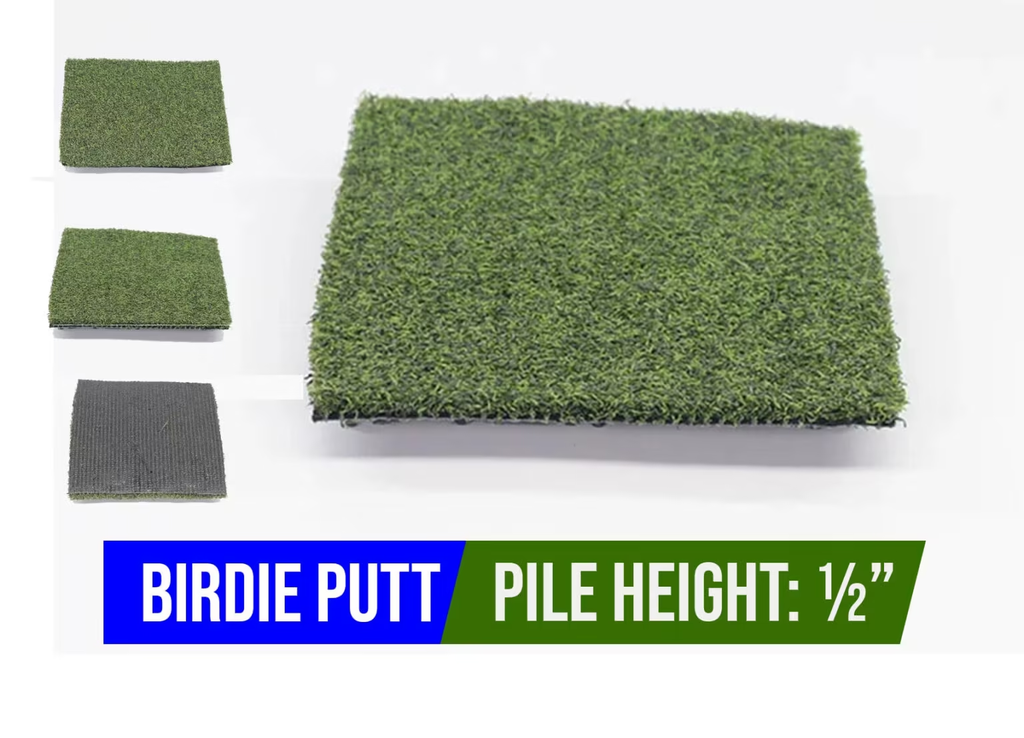
Putting surfaces use the shortest piles of all, often in the 3/8″ to 9/16″ range. A short, dense pile is what gives a true, consistent ball roll. See our putting green artificial grass selection.
What Is Artificial Grass Face Weight?
Face weight measures how much fiber is in the turf, in ounces of yarn per square yard. It doesn’t include the backing. Think of it as how much grass you’re actually getting.
A higher face weight usually means denser turf with more blades per square yard, a fuller look, a more cushioned feel, and better resistance to wear.
Most artificial turf falls between 30 and 90 ounces per square yard, with residential lawn turf typically in the 50 to 80 ounce range.
Lighter Face Weights (Around 30 to 40 oz)
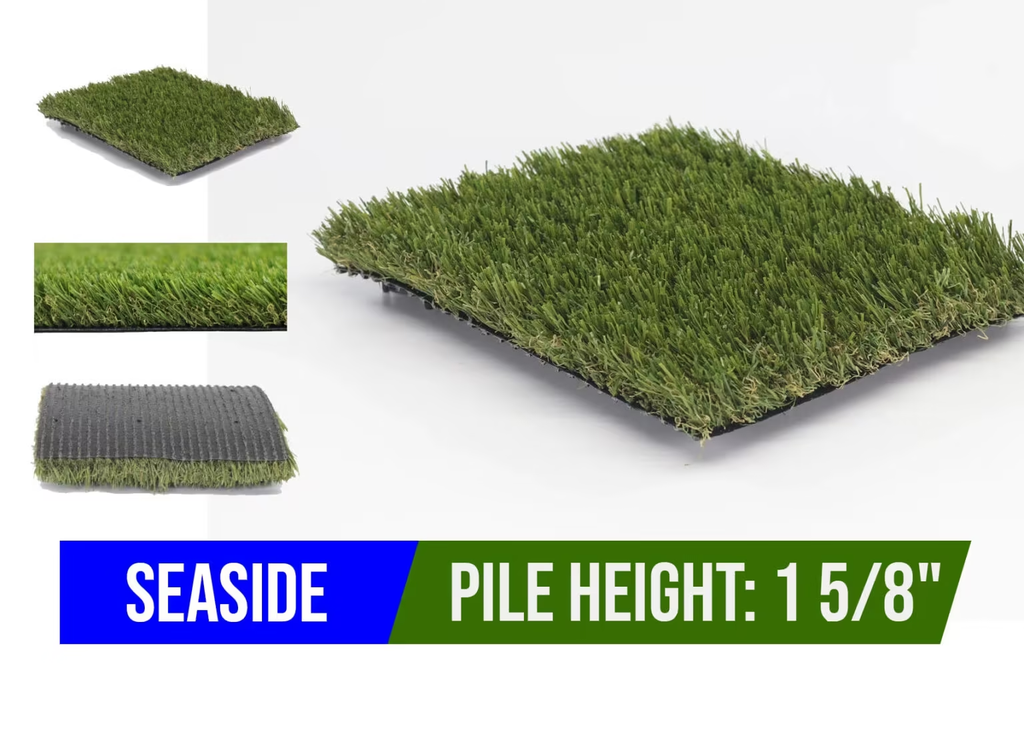
Lighter turf has fewer blades per square yard, so it can look a little less full. It still reads as grass from a normal distance and works well in the right setting. It’s usually less expensive and easier to handle during installation, which makes it a sensible choice for low-traffic and decorative areas.
Heavier Face Weights (50 oz and Up)
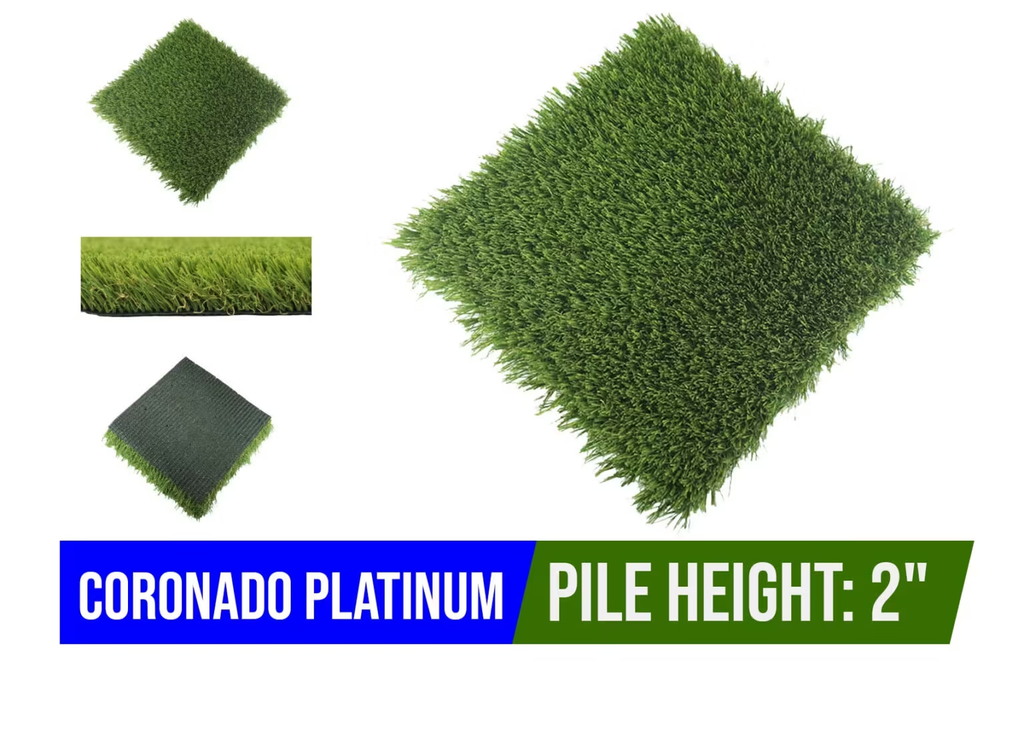
Heavier turf has more fiber packed into every square yard. It looks thick and full, feels cushioned underfoot, and stands up better to foot traffic, kids, and pets.
Examples: Marina, with a 50 oz face weight, and Coronado Platinum.
Face Weight vs. Total Weight
This is the most common point of confusion on a turf spec sheet, and it can cost you.
- Face weight is the weight of the grass fibers only.
- Back weight is the weight of the backing materials that hold the fibers in place.
- Total weight is face weight plus back weight.
Total weight is always higher than face weight. Some sellers advertise total weight prominently, which makes a turf look denser than it is. When you compare products, always compare face weight to face weight.
A real example: a turf with a 65 oz face weight and 26 oz of backing has a total weight of about 91 oz per square yard. Another turf might list a “70 oz” weight that turns out to be its total weight, meaning it has less fiber than the first one.
That said, back weight matters too. A heavier, well-built backing holds fibers more securely and keeps the turf stable, which is especially important in high-traffic areas.
How Much Does Artificial Turf Weigh Per Square Foot?
Spec sheets list weight per square yard, so divide by 9 to get ounces per square foot, then by 16 for pounds.
For common residential turfs with total weights of roughly 76 to 117 oz per square yard:
- 76 oz/sq yd ÷ 9 = about 8.4 oz per square foot, or roughly half a pound
- 117 oz/sq yd ÷ 9 = about 13 oz per square foot, or roughly 0.8 pounds
So most residential artificial turf weighs somewhere around half a pound to just over three-quarters of a pound per square foot, before infill. Infill adds more weight once it’s brushed in.
Why this matters for your project: a 300 square foot piece of turf at about 0.6 lb per square foot weighs roughly 180 pounds. Plan for at least two people to move and position rolls, and check weight limits before installing on a rooftop or balcony.
How Thick Is Artificial Turf?
Total thickness is the pile height plus the thickness of the backing. Since backing is relatively thin, pile height is the number that decides how thick turf looks and feels. If you add a foam shock pad underneath, that adds to the finished height too, which matters when you’re matching turf to patios, walkways, or door thresholds.
Other Specs That Affect Look and Feel
Pile height and face weight are the big two, but they don’t tell the whole story. That’s why two turfs with the same numbers can feel completely different.
- Thatch. Many turfs include a layer of shorter, curly fibers at the base. Thatch helps the main blades stand up and adds a realistic brown-green layer like a natural lawn. Because thatch counts toward face weight, a turf with lots of thatch may feel less dense at the top than its face weight suggests.
- Blade shape. Blade profiles (flat, ridged, curved, and others) affect how the blades reflect light, how they feel, and how well they spring back after being stepped on.
- Density and stitch spacing. How closely the fibers are stitched into the backing affects how full the turf looks from above.
- Backing and drainage. The backing determines how securely fibers are held and how water drains through. For pet areas, drainage performance matters as much as the grass itself.
- Color. Multi-tone blends with field and lime greens, plus a brown thatch, usually look more natural than a single flat green.
How Pile Height and Face Weight Work Together
Short pile + high face weight: A dense, sturdy surface that stays upright under heavy traffic. The go-to combination for pets, kids, and busy backyards.
Long pile + high face weight: A lush, thick, luxurious lawn that’s wonderful barefoot. It’s more prone to bending over in heavy traffic and needs regular brushing.
Short pile + light face weight: A neat, practical, budget-friendly option for low-activity or decorative areas.
Long pile + light face weight: Tall but sparse blades. It can work for purely ornamental spaces, but it won’t stand up to regular foot traffic.
Best Pile Height and Face Weight by Use
| Use | Pile height | Face weight | Why |
|---|---|---|---|
| Pets and dog runs | Short (about 1/2″ to 1″) | Higher | Easier cleanup, resists matting from running and digging |
| Kids’ play and high-traffic yards | Short to medium | Higher | Stays upright and holds up to wear |
| Low-traffic showpiece lawns | Long (over 1″) | Higher | Lush, natural look; brushing needed |
| Side yards and decorative areas | Short to medium | Lighter | Looks good, costs less |
| Putting greens | Under 1/2″ | Dense, short pile | True, consistent ball roll |
For pet-specific turf, see our pet grass products and the Pet Turf System.
Our Turf Specs at a Glance
Browse our full selection of landscape artificial grass for complete specs on every product.
How to Read a Turf Spec Sheet Before You Buy
- Check face weight, not just total weight. Make sure you’re comparing the same number across products.
- Match pile height to how the area is used. High traffic and pets favor shorter piles; showpiece lawns can go longer.
- Look at the backing and drainage. Especially important for pets and slow-draining sites.
- Factor in weight for installation. Heavier turf needs more hands to move and more care on rooftops and balconies.
- See and touch samples. Specs narrow your options; your hands and feet make the final call.
FAQs
What is the best pile height for artificial grass?
It depends on use. For pets, kids, and high-traffic yards, a shorter pile (about 1/2″ to 1″) holds up best and is easier to clean. For a lush, low-traffic lawn, a longer pile over 1″ looks and feels softer. Putting greens use piles under 1/2″.
Is a higher face weight always better?
Not always. A higher face weight usually means denser, more durable turf, but it’s one measure of quality. Blade shape, backing, thatch, and color all matter, and a lighter turf can be the better value for a low-traffic area.
How much does artificial turf weigh?
Most residential artificial turf weighs roughly half a pound to just over three-quarters of a pound per square foot before infill. Check the total weight on the spec sheet and divide by 9 for ounces per square foot.
What does 12mm pile height mean?
A 12 mm pile height is just under half an inch. That’s a short pile: firm, flat, and easy to maintain, suited to high-traffic, decorative, or utility areas rather than a lush lawn.
What is low pile artificial turf?
Low pile turf has short blades, typically under about an inch. It resists matting, stays upright under traffic, and is easy to clean, which is why it’s popular for pets, play areas, and patios.
Why do two turfs with the same face weight feel different?
Pile height, blade shape, thatch, fiber material, and stitch density all change the feel. A longer-pile turf with the same face weight will feel plusher than a short one, because the same amount of fiber is spread over taller blades. That’s why we always recommend seeing samples in person.
Visit Our Showroom to Compare Turf Samples
Specs get you close; touching the turf gets you the rest of the way. Visit us at 370 Umbarger Rd in San Jose, Monday through Saturday, to compare samples side by side. Call (408) 413-3915 or send us a message with questions.


[…] A durable, moderate pile. A shorter-to-medium pile with good density handles foot traffic and is easier to keep clean than a very tall, lush pile. See our guide to pile height and face weight. […]